vernon’s notebook
about me:i build, manage & sell product.
Featured Posts
what do product managers do?
The Primary Goal of a Product Manager is to ensure a product meets the needs of the customers. You can see a Product Manager as the center of the product. The person who connects the user, the customer and the engineering and marketing teams.
You will hear me say things like “I am a product guy.” But what does that actually mean ? Do I actually build stuff with my hands? No, but I have done that a couple of times. Mostly I am referring to my role of managing the product as a Product Manager.
As a Product Manager, my goal is to ensure a product meets the needs of the customers. I am the middle person between the user, customer and the rest of the organization. My job is to identify a customers needs and business objectives that the product I am managing will address.
You can see me as the bridge between what a customer wants out of our product, and our internal teams who are responsible for building that product. I own the strategic direction of a product or a feature, and ensure that I drive that direction to all teams who work on that product internally.
My job is to bring together several functions to get products out the door and into the hands of a customer. I collaborate with all the stakeholders and people working on the product, presenting what the customers needs to the team who is creating the product.
As a Product Manager, I shape and innovate existing products through iterations based on user or customer feedback, as well as envision and conceives new product ideas.
Where does a product manager fit in an organization ?
As a Product Manager, I am positioned in the center of the business, connected through constant collaboration with all departments. Think of a Product Manager as the glue between the customer, business partners, sales and the development team. A good Product Manager represents the brand to the customer. Internally, a Product Manager owns and drives the products vision.
A customer purchases a product because of the associated quality of that brand. A Product Manager is the one who is responsible for bringing that experience to the customer.
As a Product Manager you work in Cross Functional teams to deliver the products. In a standard company structure, a Product Manager would report to the chief product officer. In smaller organizations or startups, this can sometimes be a marketing officer or even directly to senior leadership.
a good product manager has some key skills
If I was to be hiring a Product Manger, I would be looking for a few essential skills for the role. A unique mix that would set that person apart. At its core, a good Product Manager understands users. To understand users, you need to have analytical and strategic thinking. A good Product Manager is a problem solver.
Not by luck or intuition, but by analyzing data and identifying patterns in user or customer behavior. Having a strong quantitative and qualitative data analyst tool kit will support identifying patterns, trends and market signals early. This is like having a super power, because using these insights will help you support your decision and help you have a strategic understanding of what the next product recommendations your team may need. Strong analytical and strategic thinking allows you to understand how your product impacts the companies growth and long term direction.
You will need to have a good understanding of the users emotional and practical experience of the product. The more difficult part, is that you will need to try predict this in advance. You will need a deep understanding of the foundations of UX (User Experience). This will empower you to make better decisions.
“Successful product managers combine user understanding, business insight, analytical thinking, and strong communication to guide products from concept to delivery—while aligning teams and driving value for both customers and the organization.”
Strong Communication and Business Acumen skills are critical to success. You need to collaborate with teams across all levels of the organization while also understanding the financial and strategic business implications of your product decisions. You are seen as a leader. A leader and champion of the product, and will therefore be expected to communicate well with external customers, and posses the ability to present your ideas and take the lead on discussions. In the sense of the product, you will need to be able to facilitate decision making.
A good Product Manager, can often be confused with a Project Manager. Many Project Managers, move onto becoming the ongoing product manager, since you need to manage the product through the complete product life cycle. This needs familiarity with the development approaches like SCRUM and AGILE.
A good Product Manager plays a key role in guiding the development efforts and ensuring that reams follow a structured strategic process.
Cheers
V
If you enjoyed this article, buy me a cup of coffee.
i used ai to gather insights from data.
Taking raw data and converting it into something you can use is a key strategic advantage that almost anyone can tap into. Previously, your trusted Data Analyst would be needed to create you a good old dashboard.
Taking raw data and converting it into something you can use is a key strategic advantage that almost anyone can tap into. Previously, your trusted Data Analyst would be needed to create you a good old dashboard.
Working in the consumer goods industry, data is key when making big decisions. This must be one of the most powerful tools that has been unlocked in our new era of AI. The best part: You do not have to be a data analyst or a spreadsheet wizard.
You can instantly generate charts and explanations that help you and your team understand the data that you are working with. You can now do complex data calculations by just using natural language.
I have been using the data from my payment terminals to identify who my top customers are, and what they are buying. Which directly influences my category buying decisions. I want to show you an example, but I am going to change the data set to protect my customer data.
I am going to show you how we can build insights from raw data, that you can use for actual decisions.
Get your Data into a CSV format.
Get your data source into an CSV format and get that imported into Google Sheets. Best to use google sheets so that Gemini can work directly with you data with no copy/paste needed.
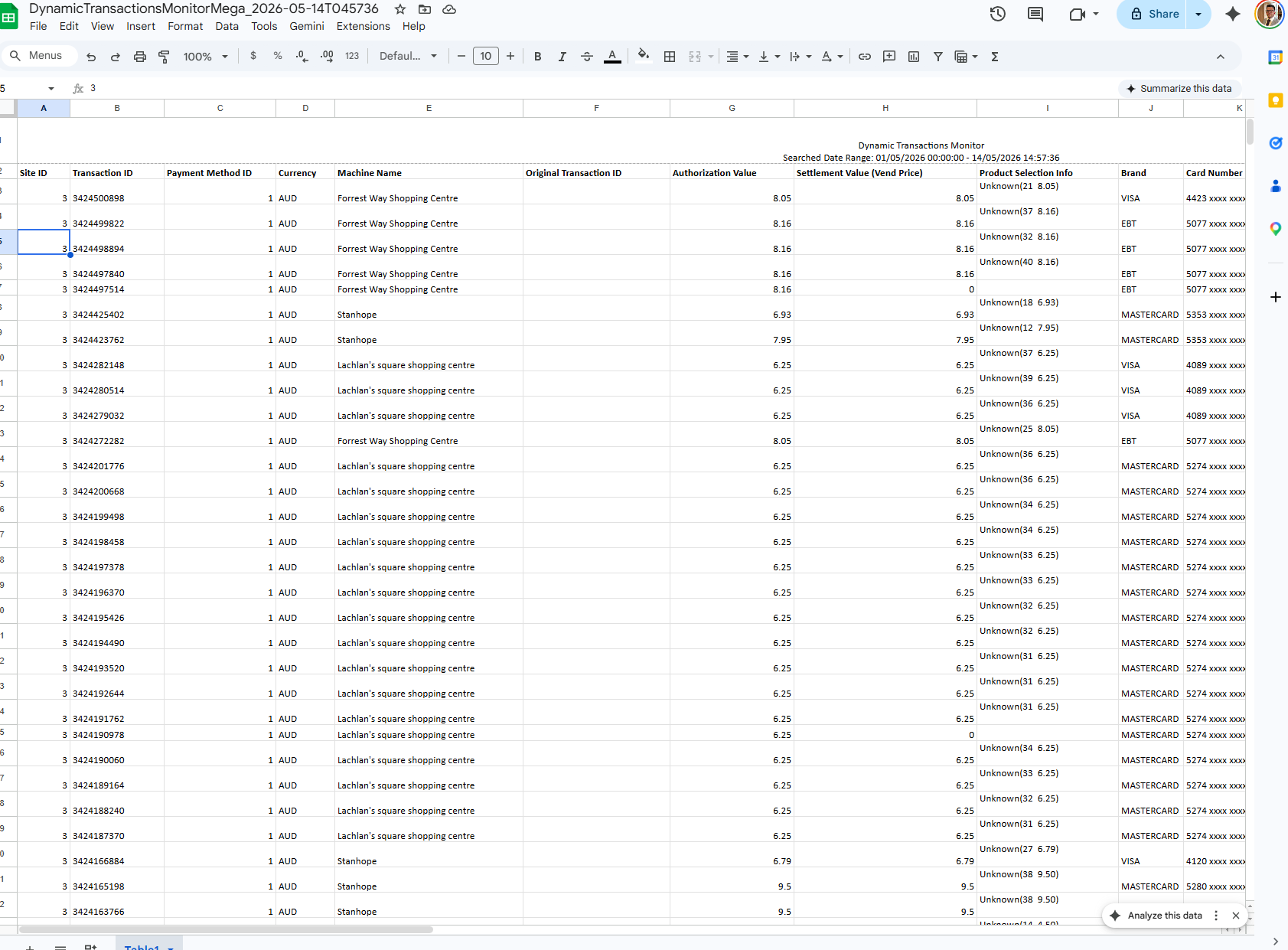
Always open Gemini from within google sheets.
This is the part where we start asking questions. I am going to share some of my prompts. Always start off with giving Gemini a persona and some context. Think like a programmer. With something as powerful as a Language Model, you need to tell it exactly what you want to do. Giving context and scope is the most important step.
“You are a data analyst. This is data from my payment terminals. Provide me the total purchase revenue and total number of transactions. ”
From the prompt above, the model now knows that it needs to analyse data, and it has context to what the data is.
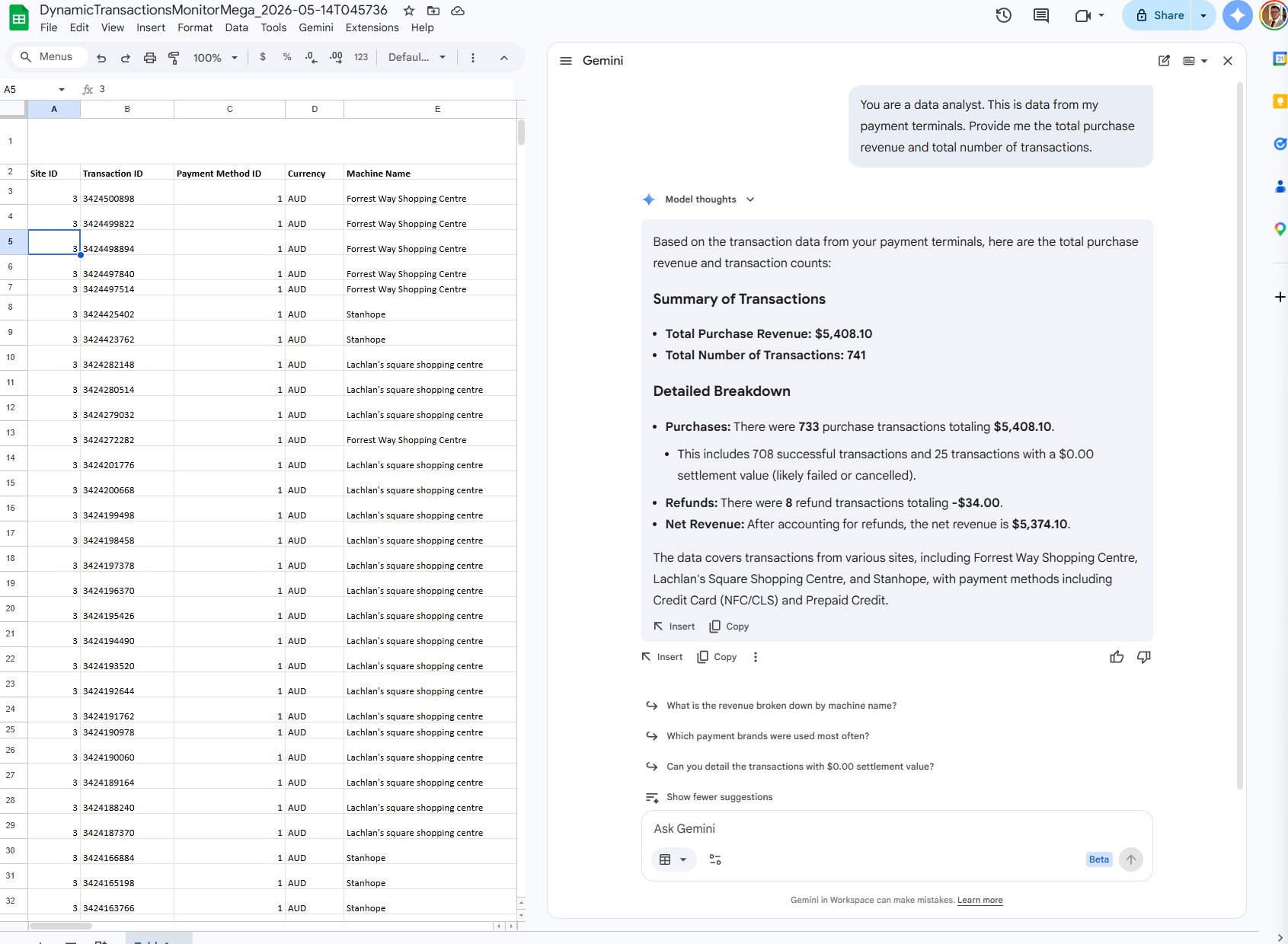
We can see from the response that we had 733 purchases and this generated $ 5 408.10
Now lets look into what my average daily sales are:
Prompt:
What are my average daily sales over the period?
“What are my average daily sales over the period?”
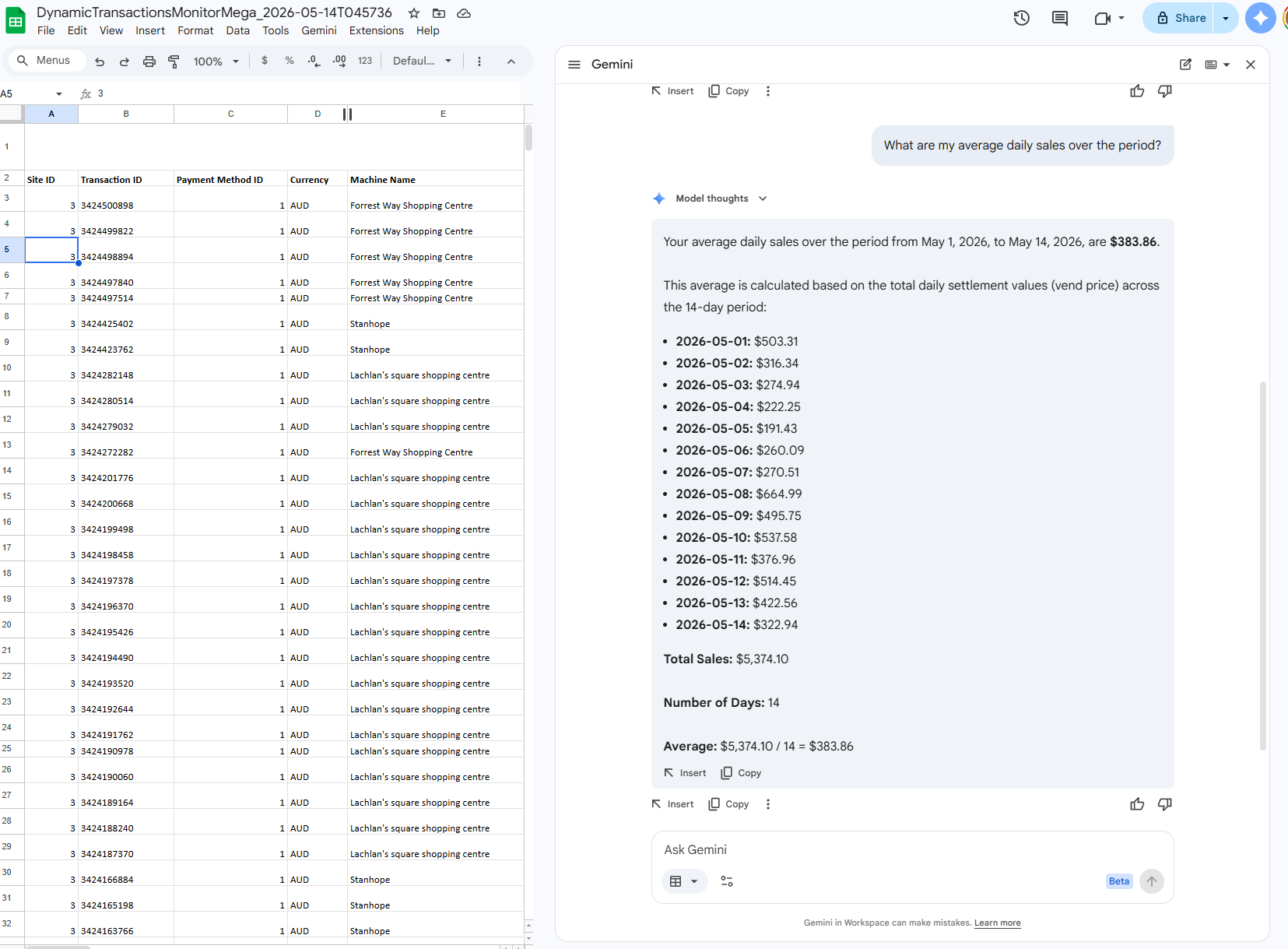
Gemini now gave me and average daily turn over of $ 383.86 over the last 14 days.
I had some refunds over the past 2 weeks . Although not much, it could be helpful to see what card brands had the most reliable transactions and generated the most revenue.
“Which card brand generated the most sales? Which card brand had the most failed transactions?”
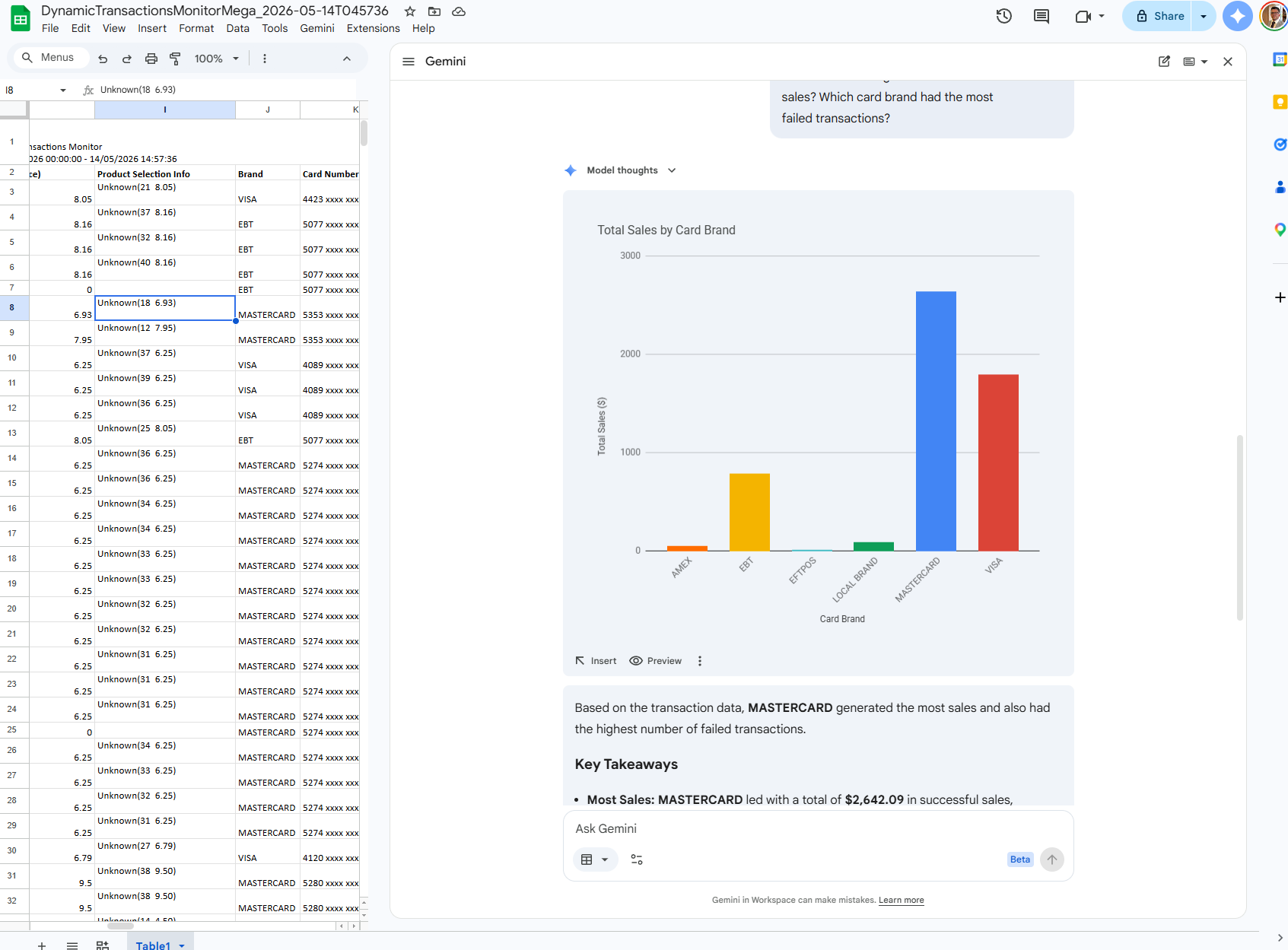
This where you can see why the original prompt was so important. The model knows the goal is data analysis, and now gave us a visual representation on the question, using its own initiative. Mastercard has the most sales, followed closely by Visa.
Since this data is from an automated vending channel, we do not know our customers. Lets see if we can get an analysis on repeat purchases and see how often this occurred in this period.
I could have told the model where to find the data, but I specifically wanted to see if the model could find other patterns or other tags to identify repeat purchases.
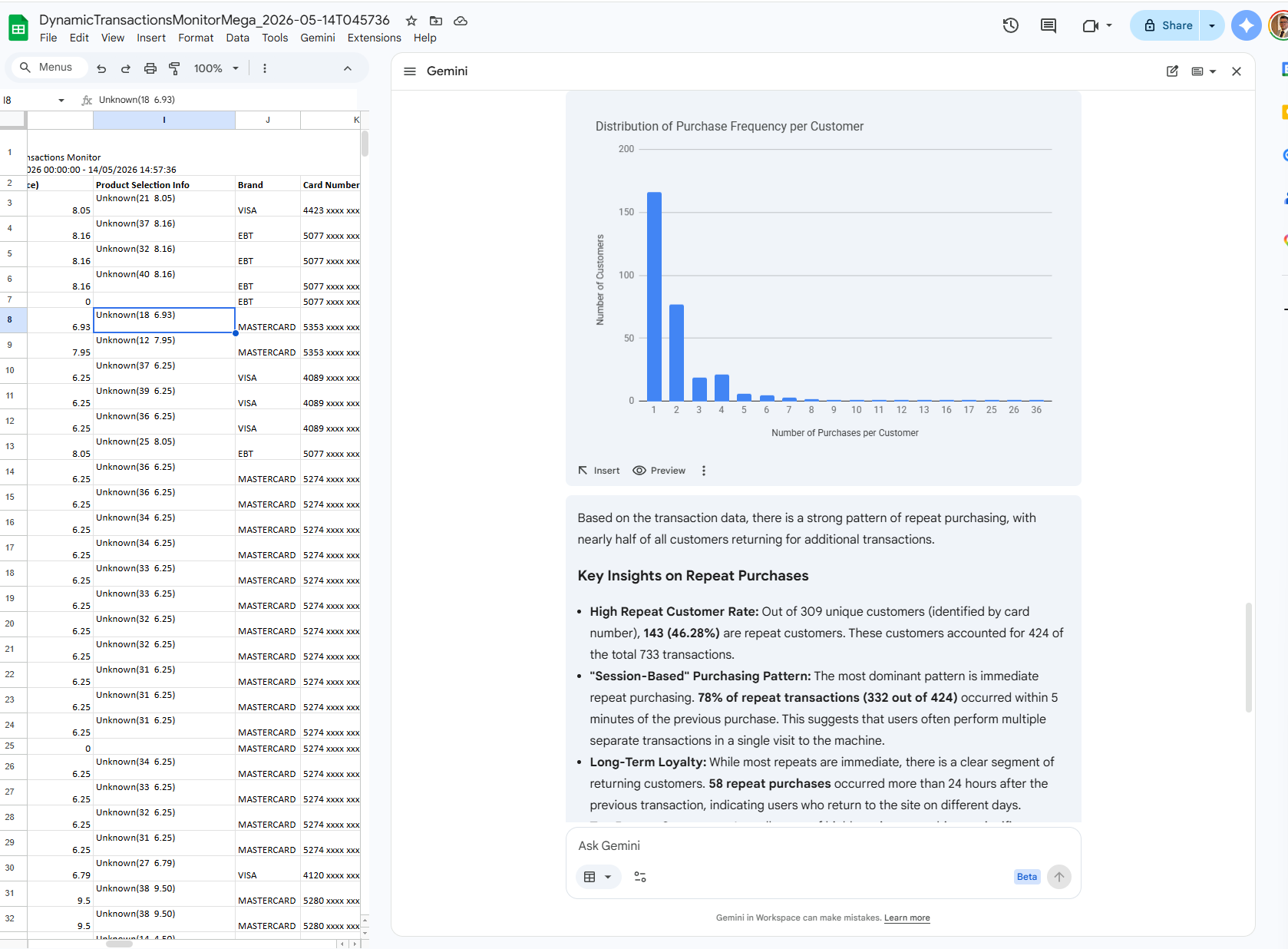
Out of 309 unique customers, over 46% of them are repeat customers. The model advised on short term repeat purchases, as well as long term loyal customers.
This is an excellent insight to extract from this data. There is value in bringing loyalty programs into this business.
A great next step would be to pitch a loyalty program to the companies leadership. Lets see how we can create a short summary, ready for a quick meeting with the companies senior leadership.
Prompt:
I will present the data to senior leadership. Create an infographic to help illustrate todays findings.
“I will present the data to senior leadership. Create an infographic to help illustrate todays findings.”
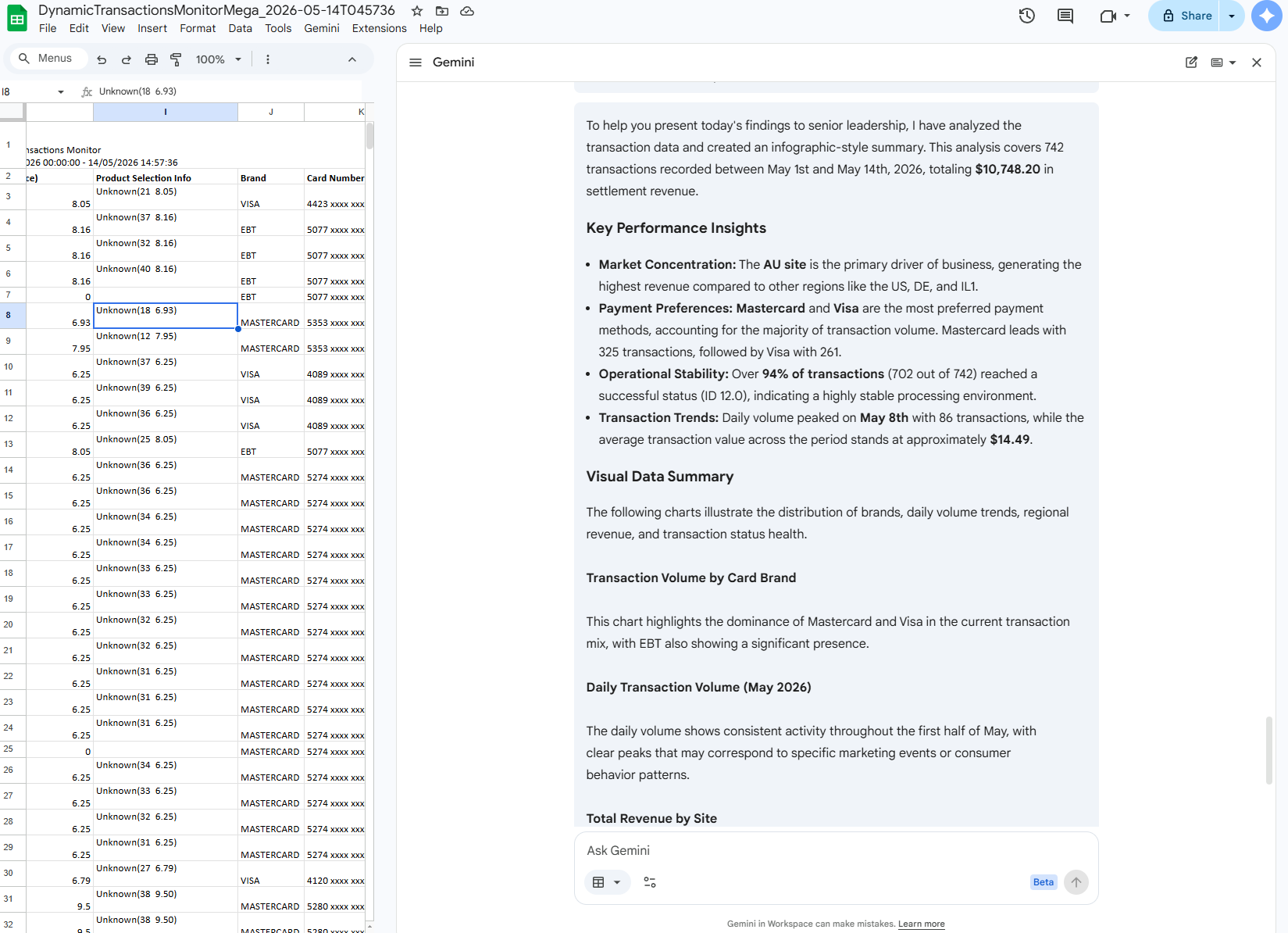
Together with bunch of infographics the model has given me a full summary of todays insights which can double as the meetings minutes.
“I want to pitch a loyalty program to help reward loyal customers. Build me a short and concise pitch i can present in this meeting with senior leadership. ”
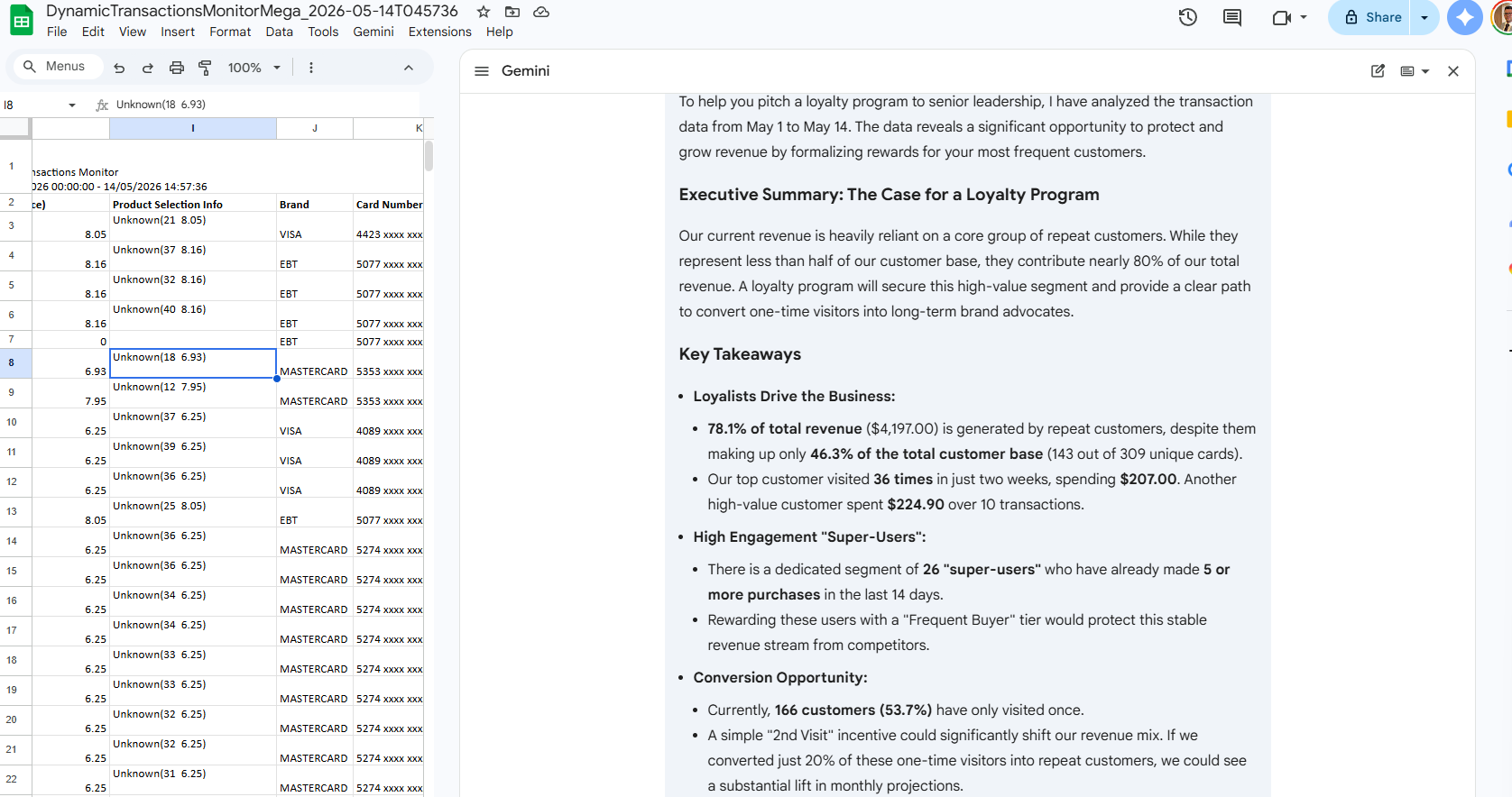
Added some key takeaways to help me with my pitch to senior leadership. Reading the data, it would almost certainly lead to increased revenue. Big slam dunk achieved from a csv file.
Spending 30 minutes using Gemini as my own Data Analyst I have made a couple of profound takeaways for my small business. Takeaways that in the past would be lost in the data.
Based on the transaction data that would have previously gone straight into the “to do list”, we have come up with the following:
Actionable insights gained from 20 minutes with Gemini posing as my own Analyst.
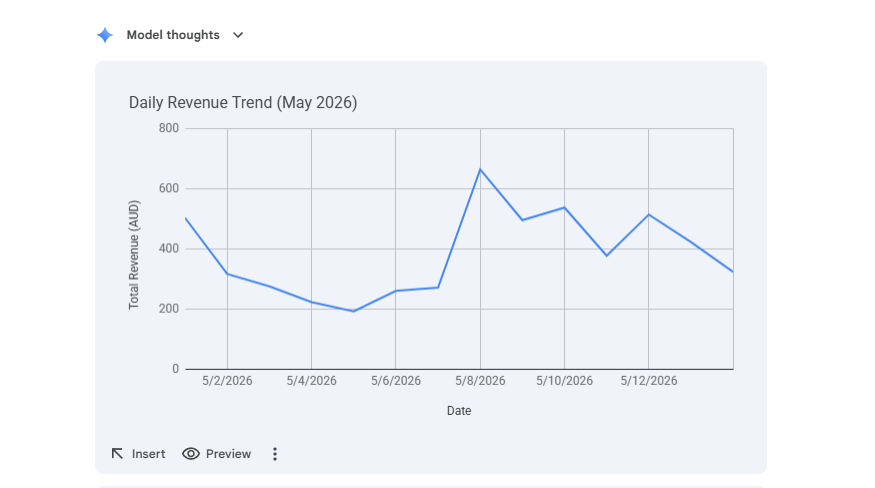
1. Strong Revenue and Transaction Volume
Total Performance: The dataset records 742 transactions, generating a total revenue of $10,748.20.
Transaction Value: The average transaction value is approximately $15.21, with daily revenue peaking on May 8th at $664.99.
Consistency: Revenue remained relatively steady throughout the period, with a notable increase during the second week.
2. Dominance of Digital and Contactless Payments
Preferred Brands: Mastercard and Visa are the most frequently used brands, accounting for 325 and 261 transactions respectively.
Payment Methods: Near Field Communication (NFC) is the primary payment method (433 transactions), followed by Contactless Reader (CLS) with 291 transactions.
Minority Brands: EBT also shows significant usage with 123 transactions, while AMEX and EFTPOS represent a small fraction of the total.
3. High Operational Efficiency and Key Locations
Success Rate: The system demonstrates high reliability with a 94.6% success rate (702 successful transactions). Only a small number of transactions (22) were flagged as potential failures (Status ID 250).
Top Locations: Stanhope is the highest-earning site, contributing $1,915.62, followed by Forrest Way Shopping Centre at $1,330.65.
Machine Performance: Machines at Lachlan's Square and Pemulwuy Marketplace also showed strong performance, each generating over $800 in revenue.
AI wont be taking away our jobs. Its changing the way we work. Look at AI as a tool to supercharge your thinking.
should a manufacture sell direct to customer?
Manufacturers should continue focusing on what they do best. Manufacturing. Taking their products directly to consumers often converts products into cheap commodities with no hope of ever changing it. Several factors in recent years have forced many to test the waters in B2C trading. Some going direct to market, while others use CBEC partners like Alixpress and Temu.
Manufacturers should continue focusing on what they do best. Manufacturing. Taking their products directly to consumers often converts products into cheap commodities with no hope of ever changing it. Several factors in recent years have forced many to test the waters in B2C trading. Some going direct to market, while others use CBEC partners like Alixpress and Temu.
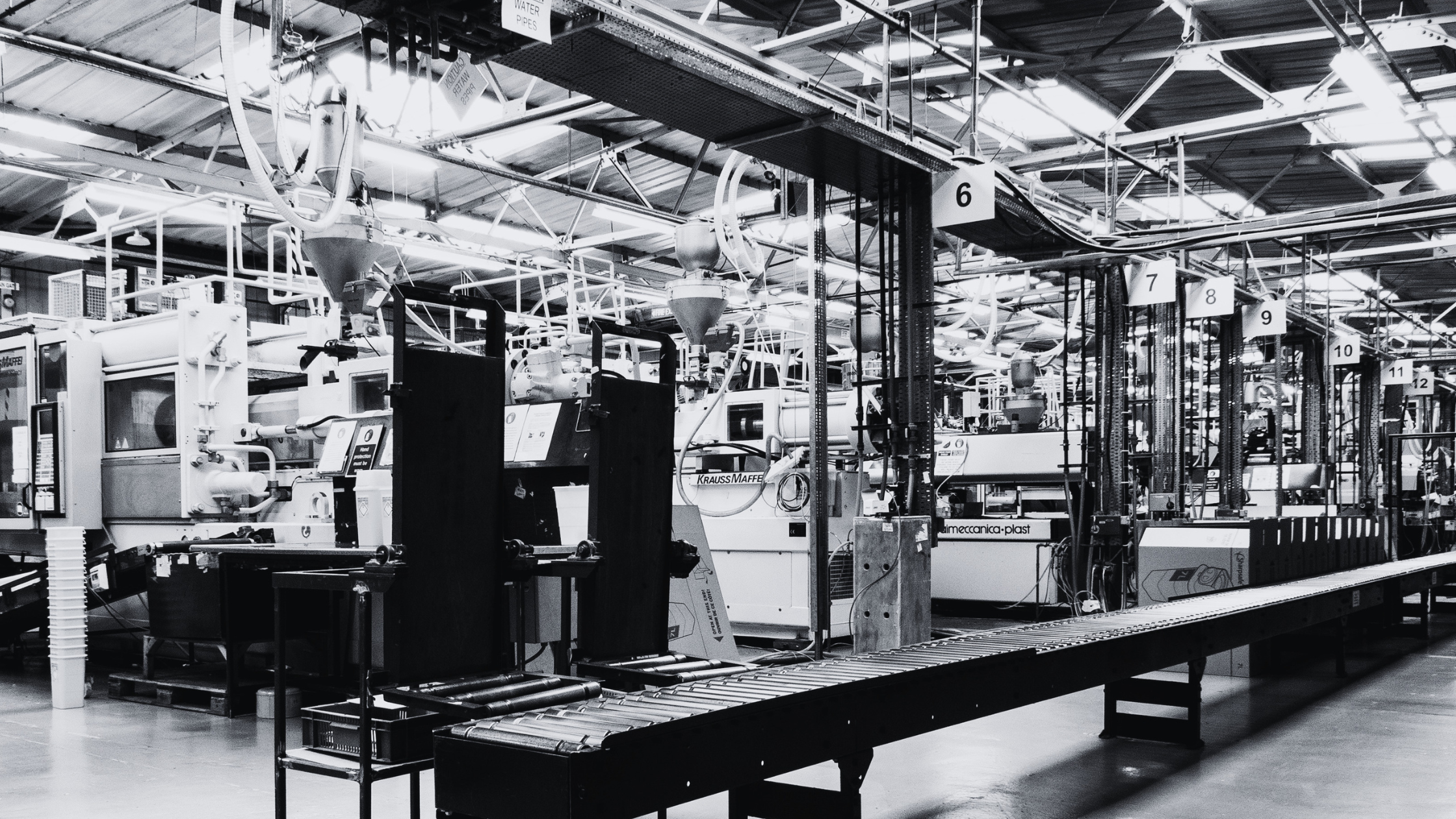
*Random image from the inside of a factory.
Why there is risk in this move?
When manufacturers go direct to market, they often go in competing on price. Not one of them. All of them. They battle each other out for market share, often believing that they can make their margins later when they own the category. The truth is that the category ownership rarely materializes. Its no secret that some battles end in negative margins to drive out competition or to close on long term, high volume deals with almost no margin.
This type of behavior happens in B2C and Private Label. Margins are usually already low, relying on volumes or other economies of scale to make money. This behavior tends to drive margins down further in an industry where there is no bottom. Slowly products become unsustainable and get discontinued.
The missing ingredient that keeps price elasticity stable ? Psychological Value.
“The concept of Psychological Value suggests that the worth of a product, service, or experience isn’t found in its price tag or utility, but in how it makes a person feel. It’s the gap between objective reality and subjective perception.“”
Selling On Price Cannibalizes Margin
I have personally seen this happen when supplying top retailers with Private Label Products, and I am witnessing the same thing from the outside with my own purchases from CBEC Partners.
With Private Label, manufacturers are obsessed with getting in with biggest Big Box retailers. With good reason, as this is where the volume and money lies. But it can come with a sacrifice. There are numerous examples of what I would call “buyers arrogance” from big box retailers.
The buyers come up with unrealistic price points and other service demands to get the deal closed. Many times, manufacturing partners close on unsustainable deals, with the expectation that things can improve later. Many times, even with the buyers backing.
But when the time comes for the factory to increase margins, life happens. Think Covid or the Iran War. This eventually leads to an unhealthy situation, which either kills the product immediately, or leads to a decline in quality. The same case can be made with CBEC partners that link factories directly to consumers. I am referring to marketplace channels, like TEMU, ALIXPRESS and Amazon. The battlefield for sales is fought on who has the best price. This leads to misjudgements in quality and customer service.
Building a psychological value on the product is the only weapon that truly works in these price wars.
Building Psychological Value
Manufacturers should focus on partnering with Brand Partners and Incubators, rather than direct to marker CBEC partners or even big Private Label deals. While the beginning of these relationships usually start with low order quantities (Which manufacturing hates), the right partner will turn this into a long and sustainable business. Manufacturing gets to focus on the challenges of their own business, like process, labour and the acquisition of raw materials, while the Brand Partners can focus on what they can bring to the table.
A good brand partner will create a brand that resonates with the market that it sells in. It speaks directly to consumers. It builds a story and purpose for the product that is relevant in the local market. It builds a User Manual that its audience understands and relates to. They assist with the strategy and positioning of the product in the market by establishing market validation and a brand identity. Things a foreign owned entity just cant do. Many do try and think they are doing well. As a local would say, its easy to see that they “don’t know what they don’t know”.
A local brand partner is a point of local connection, between not only the best retailers and sales channels, but also the best team members who add daily to the business. A good brand partner speaks local. I don’t just mean language. I mean look, feel and culture. They have the connections to distribute the product country wide with established relationships from the past. Not the type you build in a trade fair. The type you build in your high school sports team.
Manufacturers build phones, while a strong brand partner builds the Iphone. You buy an Iphone because its what you want. You pay the price for the Iphone, because the price of the phone next to it is no longer as relevant.
Manufacturing with a brand partner. ODM VS OEM
When a manufacturer is producing for a local branding partner, there are two main models that can be used. Both can have there own advantages and disadvantages. This is a topic deep enough for a full PHD, so for the sake of this POT its intentionally left light. We building price elasticity through psychological value by selecting the right production model for a good brand partnership.
ODM is a Original Design Manufacturer. This partnership model will keep the full design and engineering control within the factory. The factory designs and builds the product, while the brand partner would brand the product, handle the marketing, the story and the regional sales.
R & D Costs are almost zero. The producer has already designed and engineered the product. In most cases they have also already invested in most of the tooling needed for the production. What you might need to focus on as a brand partner is localization to your region. This is not just language related, but can also be related to things like testing, certifications and other regulations. Your R & D cost is watered down to due diligence only.
Often smaller MOQ’s because they are in most cases already building the product. The production line is setup or is ready to be setup up. In the right circumstances you can even look at options to tag onto other production runs from larger orders, although this can impact other design issues like packaging changes or other localization needs.
Technical Compliance is usually already built in. Doesn’t mean completely off your table but a lot of the ground work is already done.
The above points hit you with one huge strategic advantage. Speed to market. The design, the prototype, the fault finding and iterations are all already completed. This can reduce a 12 - 24 months development cycle into a couple of weeks.
If the above model is going to save the partnership hundreds of thousands of dollars, a little shared DNA between you and other brands is price that makes a lot of sense. Especially for a start up. Keep in mind that this shared DNA will dig into the price elasticity, meaning that reduced margins may be something you would have to put up with.
OEM is a model where the brand partner calls all the shots. Think Original Manufacturer. This model is where the Brand Partner has full control over the design of the product. They provide the blue prints and the factory simply acts as production facility. The factory will still assist in optimising the design to suite manufacturing, but the majority of the design is owned by the brand partner.
You get to create your own unique product, that is completely different to anything else on the market. Full Control of the Design and Development of the product. If you believe your product is the next big thing to dominate a category, this would be the direction you would need to go in.
You have the flexibility to change manufacturers when you need to. You own the tooling and you Own the IP outright. This is a huge plus, as it keeps the relationship fair and transparent through the possibility of competition.
Once you have paid off your initial investments like prototypes, testing and tooling your profit margins increase significantly. This allows you to scale to better profit margins the more you produce. This can keep your product highly competitive for longer, while other products are forced to push pricing higher, you may have room to absorb them.
There is more transparency on the supply chain, giving you direct control and visibility on almost every step. This can boil down to the exact grade or thickness of Stainless Steel to be used. Direct Quality Control
The best model to create the strongest psychological value will be OEM, because the flexibility allows you to fully integrate your brand identity into the product. That doesn’t make ODM a bad option as a stepping stone. Moving from ODM to OEM is often a natural progression model in most consumer catogries.
Cheers
V
a collector paid $ 16 mil for a pikachu :)
A card that could only be obtained by winning the Coro Coro Comic illustration contest in Japan in 1997–1998. With only around 40 cards known to ever exist. This Card changed hands this month for a jaw dropping $ 16.4 million. The most expensive trading card ever sold. My logical side likes to believe “the best product at the best price” was the winning recipe for a good product. But reality has proved that an Objects material worth (Production Cost) is irrelevant. What matters is how much people perceive it to be worth, or rather, how much a person is willing to pay.
A card that could only be obtained by winning the Coro Coro Comic illustration contest in Japan in 1997–1998. With only around 40 cards known to ever exist. This Card changed hands this month for a jaw dropping $ 16.4 million. The most expensive trading card ever sold. My logical side likes to believe “the best product at the best price” was the winning recipe for a good product. But reality has proved that an Objects material worth (Production Cost) is irrelevant. What matters is how much people perceive it to be worth, or rather, how much a person is willing to pay.
Logan Paul sold his Pokemon Illustrator card for over $ 16 Million US via auction, to the son of Skybridge Capital founder, Anthony Scaramucci. Upon hearing the news, my first thoughts were “if someone wants something, then there is no price ceiling”. It got me thinking of perceived value, and how different it can be between consumers.
Is it possible to recreate this type of value by design ? We have a product that has a manufacturing cost of a couple of cents that has just sold for $ 16 Million. At the very foundation, it sold for this price because us humans have decided that its worth that.
Designing a product that can do this sounds impossible. It most likely is impossible. But I had to dig into how and why this could happen, because there are lessons that can be applied in FMCG or Durable Goods. I want to take a look at the principles that could help you sell a good products at a great Margin, using this card as inspiration.
how do collectors perceive value ?
Collectors cannot be treated the same as your general consumer. There a number of primary drivers that influence the purchasing decisions of collectors. Perceiving Value in collectibles is a complicated topic and is very subjective. There can be a huge emotional influence. The pull factors can also be very different between collectors. For some, the purchase may be nothing more than Wealth Signalling. Why else would you encrust it in a flashy diamond necklace? For others, it can be as simple as getting back that special card they had as child that they lost at school.
Some factors though, can be used or translated into almost any other product.
Having something that no one else can get is what trading cards are built on. The scarcity in trading cards starts off by design. Scarcity is the core mechanic beyond what makes trading cards so fun to collect. Pokemon as an example will not print to full demand. Supply is intentionally constrained at release of a new set to maintain the chase dynamics in collecting.
The Cards Condition is often standardised through a grading agency. This grading then further plays into the cards scarcity. Cards can be assigned a value, such as a GEM MINT, which essentially means its the perfect example of what it should be. Its usually true that achieving this grade is very difficult, even for cards freshly pulled from packs and handled with care. Often, damage or factors that influence grade already occur during production.
Many collectors have an emotional connection to the products they are collecting. This is built through story telling, often tapping into a childhood connection like Pokemon created through their Cartoons, Games and Cards. Being a Pokemon collector also builds you status in a niche community.
For many new collectors the Resale Value is the primary value baseline. This has been created by media, with the various high profile trades that have occured online. Like the Pikachu Illustrator card we are basing this POT on. The stronger the resale value the more intrinsic value a collector will place on a specific card. Outside of these high profile sales there is also a huge community of creators who trade thousands and thousands of dollars in Pokemon cards.
goal: move retail price as far as possible from manufacturing cost.
I see this all the time. Products or brands cant get their products to separate from their production cost. Pricing is based on industry standards like production cost X 2.5 = Retail Price. The reality of these situations is because of continued competition, in 20 years that will be production cost X 1.5. This continues until there are one or two big players in the market. Who were the winners? I believe they are the ones who build a brand and a story. That’s what we can take away from this Pikachu card.
Not all products are collectibles, but we can apply things that work for collectibles into almost any other physical product. I would argue that it is a non negotiable. This can help companies move away from the above attachments.
Build customer relationships that last.
building relationships that last by following pikachu.
We can take some key components of the mechanics used in Trading Cards and apply them to almost any other product. Recreating these mechanics will not only justify higher margin, but will build a lasting relationship with the customer which naturally creates more price elasticity.
Scarcity is something that is created artificially in Trading Cards. It drives demand by creating a strong desire to buy the product. Wanting something you cannot get is hard. Pokemon has done this so well, that when product is released, consumers are led into riot like behavior in a battle to empty the shelves.
You can recreate similar dynamics in FMCG or in Durable Goods by creating exclusivity by design. Nestle’s Nespresso did this very well at launch. You could only purchase their pods through their exclusive retail experience. That gave them complete control over the full product experience. Buying pods almost felt like you won a competition, but you were paying for the prize.
Emotional Connection is something that can be built with customers with time. Its a factor that carries a large weight in price elasticity. The best emotional connection ever created by a brand must be Apple. Customers were loyal, and would continue to make repeat purchases even in the face of better and cheaper alternatives. In my own personal case, I do not even know what the price of a phone is. My interest is how much is an Iphone ? Why? Because that is exactly what I am buying, regardless of if there are actually cheaper and better options on the table. In my case, Apple has disconnected the manufacturing cost from the Iphone.
Grading a Card in Collectibles is a way of assigning a numeric number to the condition and quality of the card. Collectors will pay 10 times more, for something that is only slightly better quality, on the exact same product. This proves, that humans appreciate quality and will always naturally gravitate towards it. We should always apply this principle in product design. Its important though, to not get confused as to what quality actually is in reality.
“Quality = The degree to which a product consistently delivers its intended functional performance, reliability, and user experience, while aligning with customer expectations and price positioning.”
Moving a product further than anything based on the above definition of quality is a wasted cost that eats margin with no purpose. Most often, consumers are not the ones footing the bill for over designs. Its the company who made the product who has to deal with that cost. The opposite is also true. Often, we are willing to sacrifice good quality, on a whim to chase a specific price point. Our product slowly loses features, reliability or performance. This is sometimes referred to as “shrinkflation” in FMCG.
The success of a good product that makes money, is often hidden in something completely separate from the actual product itself. Its hidden in the Consumers perception of what it is. As a brand or a company, we are always full in control of what that perception is or is not.
Cheers
V